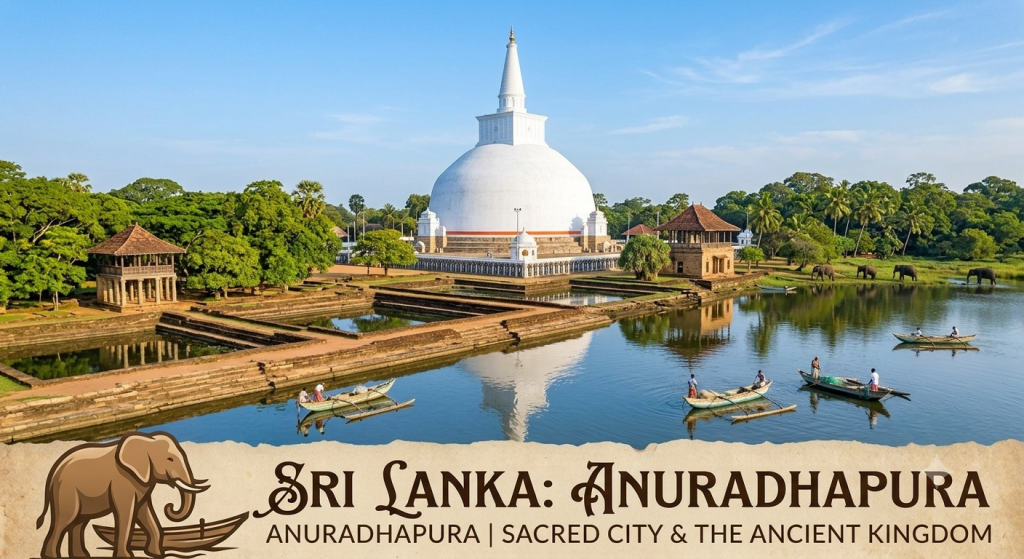
– Revered as island first Royal capital and UNESCO world heritage site.
Anuradhapura is the spiritual cradle of Sri Lanka’s Buddhist heritage. It is not a just quick stop. It is a living, breathing heritage city where history, local culture, Art and craft, rural life, spirituality, miracle of ancient engineering and diverse of nature come together beautifully. This diversity make it ideal for a meaningful, multy day stay that goes beyond sightseeing leaves visitors deeply connected to Sri Lanka’s treasure/sole.
Here history and faith flow into daily life. Every dawah, farmers tend emerald paddy fields nourished by brilliant water systems. And some villages keep alive the same traditions in farming, cooking and healing their ancestors followed 2000 years ago.
Anuradhapura is a must –visit destination for any traveler eager to explore Sri Lanka’s rich hydraulic civilization with brilliant water technology blend into a single unforgettable journey.
Anuradhapura is renowned for its majestic Stupas, monastic ruins, exquisite masterpiece of centuries old stone carvings, ancient tanks (wew) with incredible cascade system that interconnected network that protects the wewe itself is much more than simple tank and still function today despite neglected and destruction caused by development projects sustainably supporting agriculture in the dry zone.
Tank or reservoir carefully designed, manmade lake unmatched in anywhere in the world that store rain water and channel it through Ela turn dry land into fertile lush paddy fields.Explore how the scattered rocky hills shaped their brilliant system; some became natural foundations for the tank bund, while others transformed in to holy temples/hermitage /quite forest monastery or meditation retreats with stunning views across the plains.
Activities;1.Anuradhapura’s sightseeing highlights are numerous and memorable. Among them we can visit 8 holy sites few more within one day for one ticket.
i Visit the Sacred Bodhi Tree,The oldest historically documented tree in the world,grown from a sapling of the Bodhi tree under which Buddha attained enlightenment.
ii.Ruwanweli seya/ Dagaba(2nd c. BC) Restored to its original bubble shape, which is 300 ft
iii.Tuparama bell shaped Dagaba,which enshrines a right collar bone relic of the Buddha is encircled by 3rd c B.C.It is the first Stupa to be built in the island and thus the oldest in Anuradhapura.the original shape of the stupa was the heap of grains(Dhanyakara)
iv.lovahamapaya (lohapasada – Brazen palace). – a monastic establishments of 9 stories and 1000 rooms with a roof of copper tiles.After 2 millennia its stone columns still stand.
v.Abayagiriya Stupa constructed by king walagamba (1st c.B.C) 380 ft.
vi.Jethavana Dagaba (3rd c.A.D) 400ft.-the largest brick building in the ancient world.and two of mightiest monuments of the ancient world,second only to the Great pyramids at Gizeh.Their monastic complexes housed 5000 and 3000 buddhist monks in each
viii.Mirisawetiya Stupa Built by king Dutugemunu to commemorate a victory and enshrine the Buddhas’relics.
viii.Lankaramaya /Somaramaya/Mani Somaramaya .The monastery of lanka Devi or soma Devi constructed by king walagamba as a token of gratitude for his queen.Lankarama was the nunnery of the Abayagiri Vihara.
Masterpieces of Art and Architecture of ancient Sinhalese.
i.The Samadhi Buddha image in Abhayagiri monastic complex
Samadhi statue is one of finest pieces of Sinhala sculptural art. Samadhi is a Buddhist term that denotes a state of mind that is in deep concentration.
ii.The Twin ponds
A monument that adds beauty to the landscape architecture of the Abayagiri monastic complex.it is the place where monks of this monastery met their daily bath. This is the most beautiful ancient pond in the island.
The way water was managed in the two ponds also makes this pond exceptional engineering feat.
iii. The Moonstone; Sandakada pahana
A semi –circular slab of stone at the foot of a flight of steps. On it are sculptured rows of four animals one following the other, flames and flowers.Many interpreats the symbolic significance of the moonstone in a philosophical way.
It symbolizes the Buddhist concept BHAWA CHAKRA,the cycle of rebirths,in which all beings go through the four main stages I jathi (birth), iiJara(decay), iii.vyadhi(ill health),iv. Marana (Death)
iv.The Balustrade(Korawakgala) and the Guarlldstone (Muragala)
All Stupas and image houses are in general ,built on raised platforms,and four flights of steps facing the four directions to welcome the sacred area.
Korawakgala are curved stone rails or slabs placed on both sides of stairways leading up to the main platform of the building . two balustrades that flank the two sides resemble the mythical animal,Makara(dragon) .they are usually accompanied by guardstone on the side at the end and Moonstone at the bottem of the steps
At the lower end of a balustrade is a stone slab known as Muragala,a curved stone slab placed on either side of a flight of stepa leading to the Buddhist temple or royal building in Anuradha;ura period.
Guardstone served as a protective symbol,guarding the entrance to the royal palace.it was belived to ward off evil spirit and bringing blessngs to the palace.On it are sculptres of many kinds,Naga figures,Raja holding a pot of plenty(punkalasa) symbolizing prosperity and fertility,floral and animal decorations.
Activities in Anuradhapura
I participate in traditional offerings (flowers, Buddha puja, light oil lamps and prayers.
iii. Meditation retreats in Dhamma Anuradha Vipassana meditation center or Aukana meditation centre.,Labukele ,Kalaththewa
iv.Climb Mihintale,Sun rise hike.
v.Explore Surrounding lakes,Tissa wewa,Nuwarw Wewa alone tank bund .rest and soak up calm atmosphere.
- join a village lunch and cooking Demostration.experience authentic Sri Lankan village cuisine with lake fish dish prepared in clay pots by traditional firewood hearth or wood -fired stove at farm stay.
vii. visit a chena cultivation or organic farm where wild and old varieties of vegetables plots with a guide, join harvesting and have boiled maniyok or sweet corns.
viii. visit local paddy field and join harvesting, ploughing (seasonal)
ix .Explore Saturday and Sunday fair and taste variety of fresh tropical fruits.
- paddle traditional canoe to hand plucking lotus often used for temple offerings or enjoy traditional fishing in a serene lakes.